I spent about ten years at Farmers leading technology and marketing teams, the last two as a VP on the distribution side. My job was bringing technology that improved how agencies managed their pipelines — lead management, marketing campaigns, CRM.
That work meant being deep in agency operations every day. I saw what separated high-performing agencies from struggling ones, and the patterns weren't subtle.
The top 20% of agencies weren't winning because they had better leads. They were winning because they had a better process — with higher conversion at every step of their pipeline.
The bottom 80% kept buying more leads. But their pipelines had structural gaps — predictable, fixable, and almost universal across the independent agency channel. It's like trying to fill a leaky bucket.
This is a breakdown of the five most common leaks I see when I work with independent agencies today. None of them are shocking. But all of them are leaving real money on the table.
Leak #1: Buying Unqualified Leads (or Targeting the Wrong Ones)
This is the leak agencies talk about the most and fix the least.
Most independent agencies have a lead source mix that looks something like this: 30% from internet leads (EverQuote, MediaAlpha, QuoteWizard), 30% from carrier-supplied leads, 20% from referrals, and 20% from local marketing or LSAs. The problem isn't the mix — it's that most agencies don't track close rate by source.
When you don't measure it, you don't fix it. Most agencies are paying $15–30 per shared lead from a vendor where the realistic close rate is 1–3%, while spending the same effort on a referral lead that closes at 40%+. The math is brutal once you actually look at it.
What to do about it:
- Track close rate by lead source for 90 days
- Kill the bottom-quartile sources
- Reallocate the budget to your top-quartile sources or to local LSA/SEO
- Add basic qualification questions to your intake (current carrier, renewal date, claims history) so producers spend time on real prospects, not tire-kickers
The agencies that fix this leak typically see 20–30% close-rate improvement within a quarter — not because they got better at selling, but because they stopped wasting time on leads that were never going to close.
Leak #2: No Quote Follow-Up Sequence
Here's a number that stops people: industry data suggests about 60% of insurance quotes never get a follow-up touch after they're sent.
The producer pulls a quote, emails it to the prospect, and moves on to the next lead. The prospect was busy that day. Or wanted to compare. Or got distracted. The quote sits in their inbox for two weeks, then gets buried, then forgotten.
That's not a closing problem. That's a follow-up problem.
The agencies that fix this typically run a 5–7 touch follow-up sequence after every quote. It doesn't have to be complicated:
- Day 1: Quote sent + voicemail
- Day 3: Email check-in ("any questions on the quote?")
- Day 7: Phone call
- Day 14: Email with a specific value point ("noticed you have a teen driver — here's what that means for your premium")
- Day 21: Final touch with a deadline ("this rate locks in until X date")
What's striking about this leak is how cheap the fix is. You don't need new technology. You don't need more leads. You need a CRM workflow and the discipline to run it.
Agencies that go from 1–2 touches to 5–7 touches typically see quote-to-bind conversion lift by 20–40%.
Leak #3: Slow Lead Response Time
This is the leak with the most data behind it, and it's usually the biggest single revenue gap I see.
Research from MIT and InsideSales analyzing thousands of B2C lead funnels found that leads contacted within 5 minutes are 9x more likely to convert than leads contacted after 30 minutes. Insurance leads age faster than almost any other category — most online insurance shoppers are filling out forms on multiple sites simultaneously.
If you respond in 4 hours, you're not "fast." You're 49th in line.
Most agencies think they're fast. The data says otherwise. When I've audited agencies, the median first-response time on inbound leads is usually 30–90 minutes during business hours and 12+ hours overnight or on weekends.
What to do about it:
- Set up automatic email response triggered the second a lead comes in (acknowledgment, basic FAQ, calendar link)
- Route leads to producer cell phones, not just shared email inboxes
- For after-hours leads, an automatic acknowledgment is critical — even a basic "we got it, expect a call by 9am tomorrow" beats silence
- Measure first-response time as a KPI. Display it. Make producers aware of it.
Agencies that go from 30-minute response time to 5-minute response time typically see lead-to-quote conversion lift by 40–80%. Same leads. Same producers. Just faster.
Leak #4: Renewal Drift
Most independent agencies treat renewals as a passive event. The carrier sends the renewal notice 30 days out, the client either pays or doesn't, and the agency finds out about cancellations after the fact.
Top-quartile agencies treat renewals as an active sales cycle.
Industry retention benchmarks for personal lines independent agencies sit around 88–90%. That sounds high until you realize: a 90% retention rate means losing 10% of your book every year. For a $1M revenue agency, that's $100K in commission walking out the door annually — and most of it is silent. Clients don't tell you they're shopping. They just don't renew.
The agencies that fix renewal drift typically run a structured pre-renewal sequence:
- 75–90 days out: Account review touch — call or email asking about life changes, new vehicles, new property
- 45–60 days out: Coverage gap review — proactively flag underinsurance or new exposures
- 30 days out: Premium change communication — get ahead of any rate increases with context
- At renewal: Confirm + thank + ask for referral
This is also the highest-leverage point for cross-sell (Leak #5). A client at renewal is paying attention to their insurance for the first time in 12 months. That's the moment to expand the relationship, not just preserve it.
Agencies that move from passive to active renewals typically lift retention by 3–5 percentage points. On a $1M book, that's $30–50K in retained revenue annually.
Leak #5: No Cross-Sell Discipline
The average independent agency household carries about 1.6 policies. Top-performing agencies hit 2.5 or higher.
That gap isn't because top agencies have better clients. It's because they have a system.
Most agencies cross-sell opportunistically. A client calls in to add a vehicle, the CSR notices they don't have an umbrella policy, they mention it. Sometimes it lands. Most of the time the client is busy and says "send me info" and nothing happens.
Top agencies cross-sell systematically:
- At new business binding: Every new auto policy triggers a home conversation (and vice versa)
- At renewal: Every renewal includes a coverage review that explicitly looks for gaps
- At life events: New baby, new home, new job, marriage — each has a documented cross-sell trigger
- Annual reviews: A scheduled check-in for every household, not just the ones that call in
The economics are dramatic. Adding a single line of business to an existing client typically:
- Costs ~10% of the acquisition cost of a new client
- Increases retention by 8–15 percentage points (multi-line clients are stickier)
- Increases lifetime value by 60–100%
If your agency averages 1.6 policies per household and you can move that to 2.0, you've effectively grown the book by 25% without acquiring a single new client.
What These Leaks Have in Common
Every leak on this list has three things in common:
- They're systemic, not personal. Slow response times, missed follow-ups, weak cross-sell — these are usually not an effort or talent problem. They're a workflow problem. The structure to do the right thing consistently doesn't exist or isn't enforced.
- They're easy and quick to fix. Some are process changes, others are basic automation. Most can be implemented in weeks for real, measurable upside. My recommendation: pick your biggest leak, fix it, and focus on it for 2–3 months. Then repeat with the next one. Trying to fix everything at once is how nothing gets fixed.
- They compound — massively. Fixing one leak helps fix the next. Better lead targeting feeds better follow-up. Better follow-up feeds better retention. Better retention feeds better cross-sell. And small conversion improvements at each stage stack into outsized revenue gains. See how much one small improvement in one stage can move your total revenue.
But here's the part most agencies miss.
It's not just that the top 20% have better processes. It's that better processes create an unfair economic advantage that compounds over time.
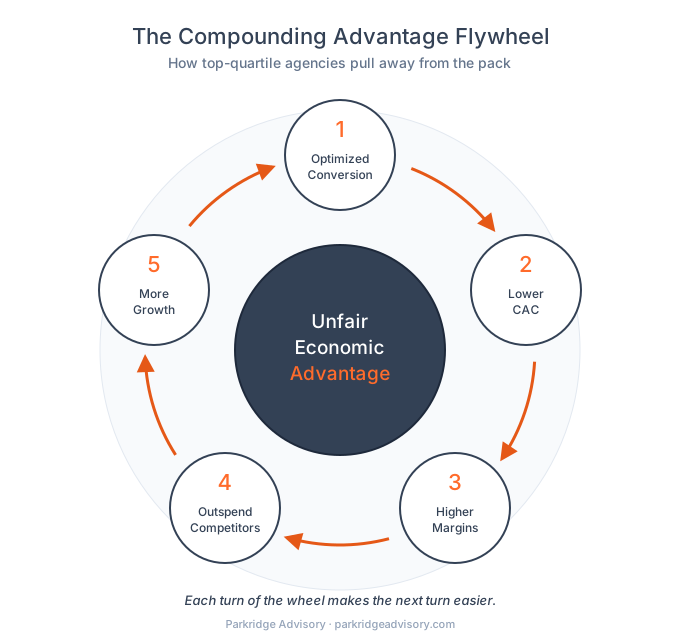
Better conversion at every step of the pipeline means lower CAC. Lower CAC means more profit per policy. More profit per policy means the budget — and the discipline — to outspend competitors on the acquisition channels that work. Which means more leads. Which means more sales. Which means even more budget.
This is why the gap between top-quartile and bottom-quartile agencies keeps widening. The bottom 80% are stuck in a loop: high CAC, thin margins, no budget to grow, blame the leads. The top 20% are running the opposite loop: optimized conversion, low CAC, fat margins, room to invest, pulling further ahead every quarter.
The agencies that win this decade won't be the ones with the biggest ad budgets. They'll be the ones with the lowest CAC — because that's what funds the biggest ad budgets.
Pipeline optimization isn't a nice-to-have. It's the unfair advantage that decides who wins.